SCAMS
Common SCAMS
And How To Protect Yourself From Them
Criminals and con artists use many schemes and techniques (known as scams) to target unsuspecting people to get access to their money and personal identifiable information. Consumer scams happen on the phone, through the mail, e-mail, or over the internet. They can occur in person, at home, or at a business. R.O.S.E. will show you several steps you can take to protect yourself, your money, and others from fraud and scams.
A few of the ways to protect yourself and your money:
- CHECK YOUR EMOTIONS - Scammers play on your emotions to get you to act quickly and use social engineering (exploiting your emotions).
- TALK TO YOUR TRUSTED PERSON - Call a family member or friend to get their opinion about the information, email, or phone call you received.
- VERIFY BEFORE TRUSTING. Scammers want you to think that they are the bank, police agency, computer tech company, etc. Hang up, close the email, and take a moment to call the company they are purporting to be. Do not call a number the scammer gives you, call the official number from your bank statement, the back of your credit card, etc.
- WRITING CHECKS - use a pen with gel ink (unibal 207 has passed many check washing tests) If mailing a check take it into the post office rather than leaving it in your mailbox or putting it into a blue mailbox.
- SHRED - important documents using a crosscut shredder.
- GOVERNMENT CALLS - Government offices (e.g. IRS, Social Security, the courts) will not unexpectantly call you.
- GUARD PERSONAL INFO - Keep your personal information confidential including your multifactor authentication codes (turn off your text preview on mobile phone), usernames, passwords, and any other personal confidential information. If you have a caregiver, cleaning person, or other service person come into your home make sure this information is not accessible to them.
- SHARE - what you learn with family and friends.
There are so many different types of scams and scammers are constantly coming up with new scams and techniques. We created the Anatomy of a Scam so you will have a better understanding of scams in general and be better able to recognize a scam. To learn how R.O.S.E. can help you, click
Common Frauds Commonly Affecting Over 60 Individuals
(from the 2025 IC3 Elder Fraud Report)
Investment Fraud: Deceptive practice that induces investors to make purchases based on false information. These scams usually offer those targeted large returns with minimal risk. (Retirement, 401K, Ponzi, Pyramid, etc.).
Criminals pose as technical or customer support/service. The criminal may impersonate any type of personnel appearing to offer support or assistance, including (but not limited to) computer/virus support; virus software renewal; banking; online shopping websites; utility companies; security (including virus software renewal); GPS; printer; cable and internet companies; and cryptocurrency exchanges.
Confidence/Romance scams occur when a criminal adopts a fake online identity to gain an individual’s affection or confidence. The scammer uses the illusion of a romantic or close relationship to manipulate and/or steal from an individual. They gain trust and eventually will ask for money.
Scam targeting businesses or individuals working with suppliers and/or businesses regularly performing wire transfer payments. These sophisticated scams are carried out by fraudsters by compromising email accounts and other forms of communication such as phone numbers and virtual meeting applications, through social engineering or computer intrusion techniques to conduct unauthorized transfer of funds.
A government official is impersonated to collect or extort money.
Cryptocurrency kiosks are ATM-like devices or electronic terminals that allow users to exchange cash and cryptocurrency. Criminals may direct victims to send funds via cryptocurrency kiosks. According to IC3 data, the use of cryptocurrency kiosks to perpetrate fraudulent activity against the US population is increasing. In 2025, the IC3 received more than 13,400 complaints reporting the use of cryptocurrency kiosks, with losses over $388 million — a 23% increase in complaints and a 58% increase in losses from 2024. More than half of the complaints involved individuals over 50, with losses over $302 million.
AI provides augmented and enhanced capabilities to schemes that attackers already use and increases cyber-attack speed, scale, and automation. Cybercriminals are leveraging publicly available and custom-made AI tools to orchestrate highly targeted phishing campaigns, exploiting the trust of individuals and organizations alike. These AI-driven phishing attacks are characterized by their ability to craft convincing messages tailored to specific recipients and containing proper grammar and spelling, increasing the likelihood of successful deception and data theft.
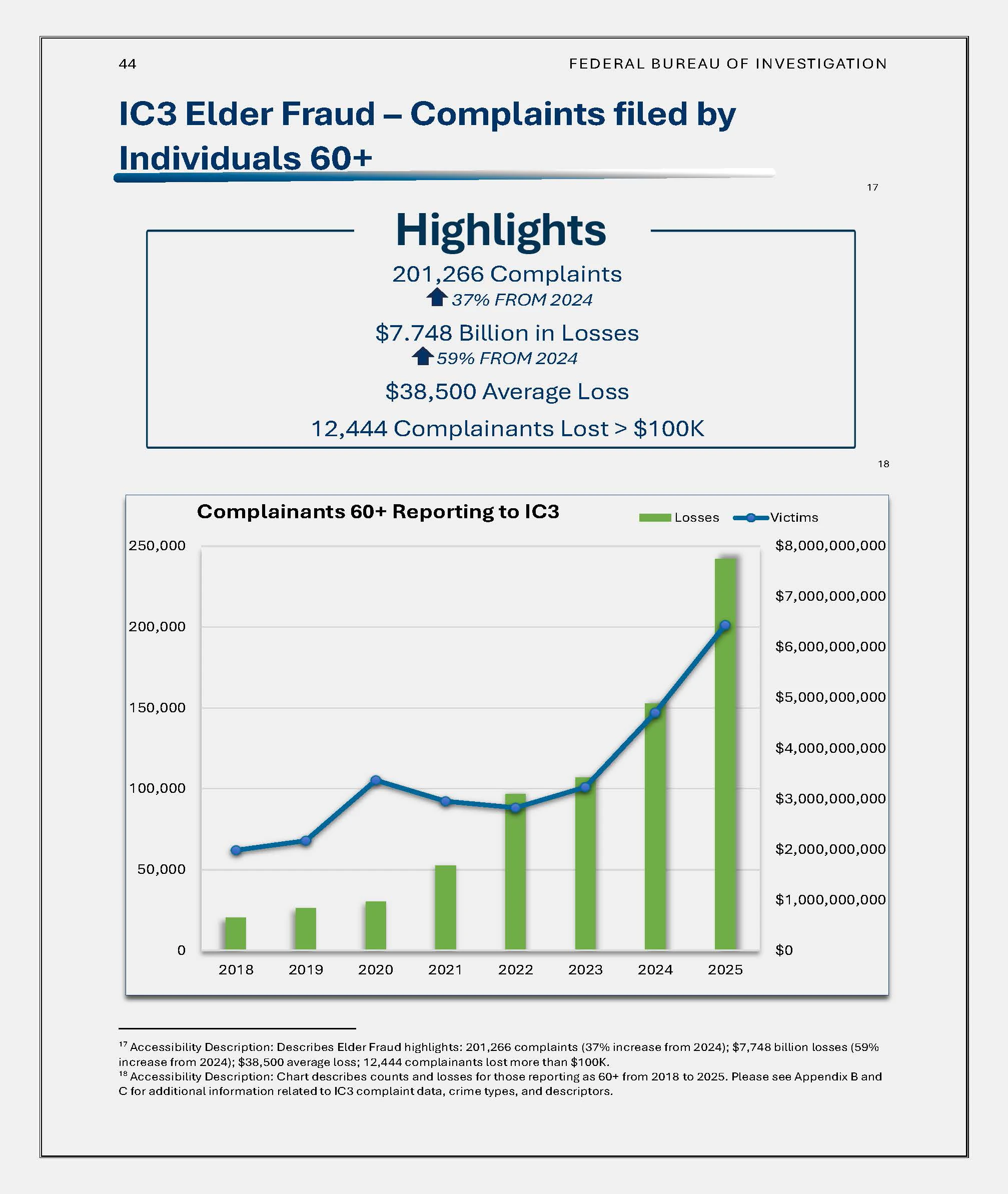
Note: The Elder Fraud Report begins on page 43.
The following report is from the
2025 IC3 Elder Fraud Report
To Report a Scam:
Consumer Fraud and Identity Theft
Or Call the FTC Consumer Response Center at
1-877-FTC-HELP (382-4357)
Health Care Fraud, Medicare/Medicaid Fraud, & Related Matters
Or Call Health & Human Services At
1-800-HHS-TIPS (447-8477)